
What can we prototype?
In simple terms, what we might consider creating a prototype for are the kinds of things that we might we otherwise use sketches and wireframes to explore and design.
We'll now review some of the items for which prototypes are particularly helpful in the design of a website.
Information Architecture and Structural Elements
Presenting a site’s structure as a sitemap diagram to the project team and stakeholders is often ineffective. It's even harder to user-test structural elements with such a diagram. At a more granular level, we have the same problem testing and presenting other aspects of information architecture including structure, behavior and labelling in navigation, or taxonomies (such as the categories users can employ to segment and query products in an online shop).
It's possible to build an interactive prototype and populate it with real structural elements (for example, primary and secondary page navigation, product categories). Then we can test these structures: the page hierarchy, the behavior of the navigation, and the labels that we're proposing with real users given real tasks to perform. We can present our information architecture to stakeholders in an exciting, tangible way that they can visualize and explore.
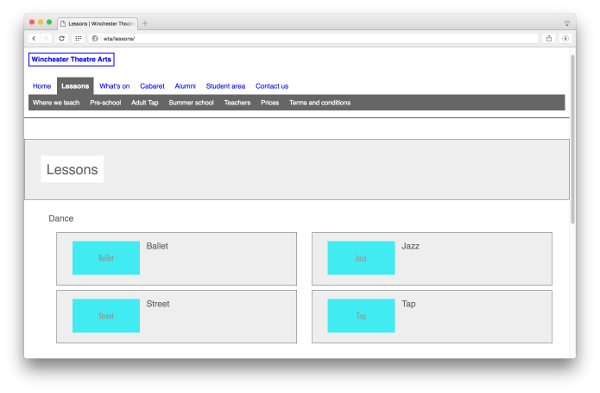
This lends itself particularly well to the loading of real content for prototyping then being used for production. We can start at a low level of fidelity by loading the structure of a website into a content management system (CMS) database for a prototype. Then we can increase fidelity by adding placeholder content, then further still by adding in real content. This content can then potentially be used in a production implementation. We'll talk about this in detail in Chapter 7.
Layout and Visual Hierarchy
We can use a prototype to design, test, and communicate the overall layout and hierarchy of elements that make up a page. This is the kind of design where we’d traditionally use wireframes.
Take the example of a site presenting a range of vacuum cleaners. We might have a list of all cleaners grouped or categorized in a certain way; for example, a page for each individual cleaner showing specifications, options, and user reviews. We have to decide what content to present in the listing and what to display on a single cleaner page, as well as how to lay them out.
We can use insights from user research to help us, such as the tasks different types of users are trying to achieve, what information is needed to solve those tasks, and what’s considered important / less important. From there we can come up with a proposed layout for the listing and for the single page. Then we can implement that proposal in a prototype, ideally using some real content.
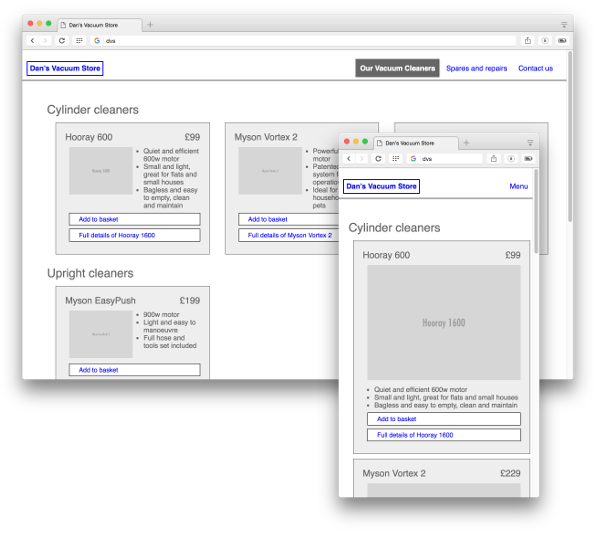
A prototype enables us to present the proposal to stakeholders and to test it with real users. Over the lifetime of our prototype, we can add, remove, and change content, as well as alter the layouts we're proposing. We can test small changes or radical alternatives to the layout. If our prototype’s implementation has a good separation of content and presentation, the process of changing the layout while maintaining the same base content is easy. That means we can test more layouts, more quickly and more easily.
Interactive Elements
All websites have at least some interactive elements (such as a link), but many have interactive elements that are more involved and complex. This requires significant amounts of user interface design.
Consider the example of an ecommerce site selling clothes and accessories. Users tend to have varying requirements in narrowing their clothing searches, whether it’s by size, color, season, garment type, fabric, brand, and so on. This often leads designers of an ecommerce store to consider a faceted navigation pattern, where users can narrow their search across several sets of criteria––for example, medium size, yellow color, and cotton fabric––and see the results promptly.
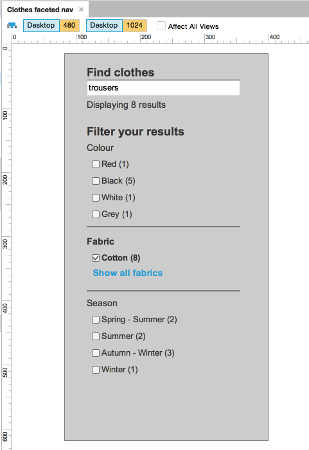
While it sounds straightforward enough, this is a remarkably complicated feature to design. The ability of a prototype to help us try out ideas for laying out categories, their method of interaction, and which categories to narrow results by will significantly improve our chances of doing it justice. We can use a decent set of representative content to quickly implement a range of ideas for presenting and interacting with that content. We can communicate our ideas with stakeholders and test them out with real users––iterating, changing, and experimenting as we go.
Without a prototype, this kind of rapid iteration could only happen once the online store had been (at least) partially implemented. Prototyping allows us to do it earlier, quicker, and cheaper.